The differences between home and professional mobile signal solutions

The differences between home and professional mobile signal solutions


Professional mobile signal solutions

cell phone signal boosting

Professional Mobile Signal solutions

You’re probably already familiar with the basic functioning of a mobile signal repeater, and the advantages of having a powerful mobile signal to make and receive calls, surf the Internet at high speed, and enjoy a whole lot of services on your mobile. As you will know, the repeater’s job is to receive the existing mobile signal outside, amplify and distribute it inside your building.

When it comes to purchasing a repeater, it is good to know the differences between signal repeaters for home use and the ones used in commercial and professional environments and their quality.

So, should you go for a home mobile signal repeater or a professional one?

To answer this question, let’s have a look at the differences between the two: Professional mobile signal solutions

1) Range (coverage area)

One important difference between a signal repeater for use at home and one for use in, for example, a large office building, is the internal coverage.

Professional mobile signal solutions

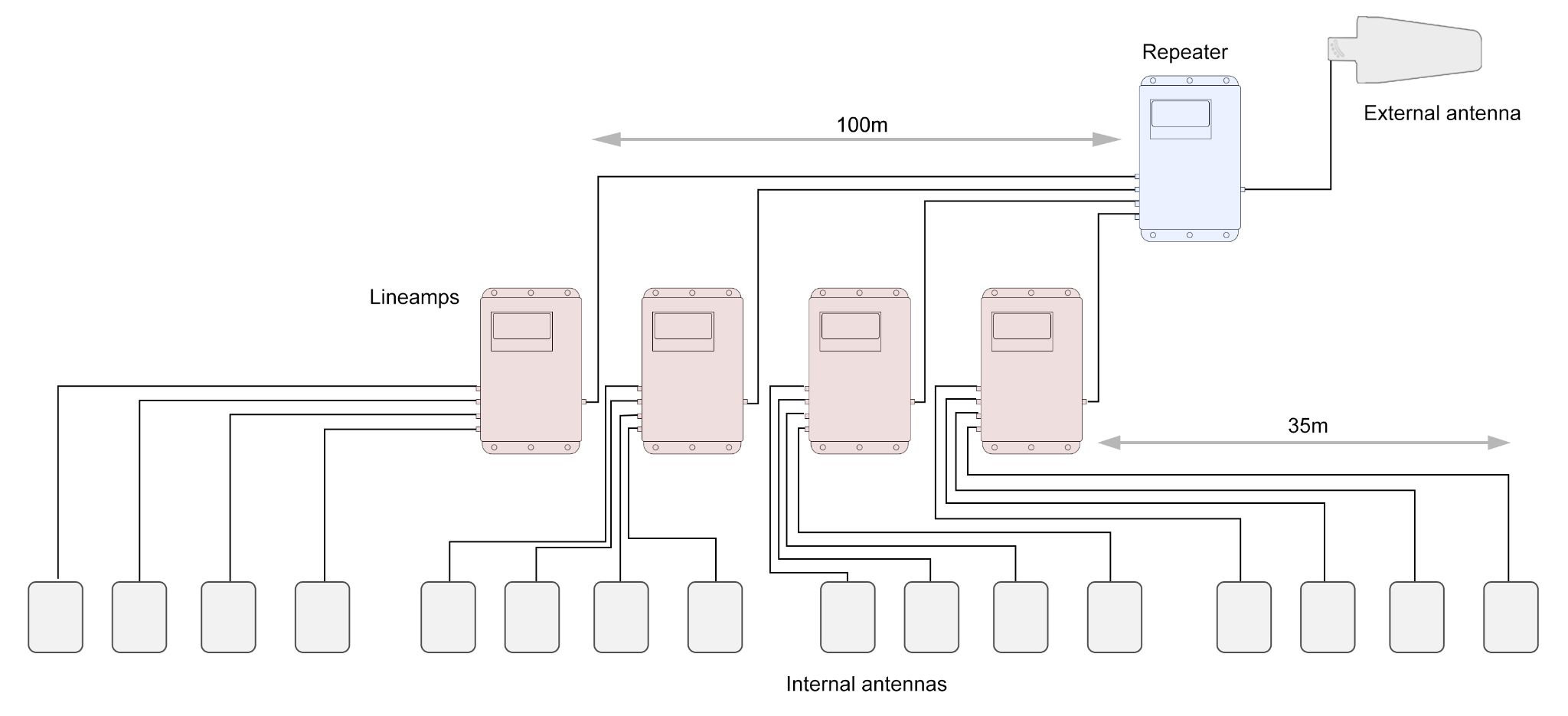
Home signal repeaters can cover the equivalent of 4 normal sized rooms in a house, while large area repeater systems have a range that can be adjusted to suit the customer’s needs. If you want to amplify the mobile signal in your home or small office, a home repeater such as the Stellahome will work perfectly well for you. However, for multi-storey offices, large commercial premises, airports, hospitals, etc., you will need a professional repeater system such as the iRepeater (iR6). The i-repeater is part of our modular system, where you can add as many amplifiers as you like. This allows you to bring the mobile signal deep inside your building. Our i-Repeater system is regularly installed in multi-storey buildings up to 70 floors!

Professional mobile signal solutions

The image below shows 1 repeater used in conjunction with 4 lineamps. This gives us 16 internal antennas.

Total Coverage is approximately 60 rooms. Professional mobile signal solutions

2. Unlike home repeaters, commercial repeaters like our iR6 allow you to monitor (over the internet or locally via the LCD screen) the signal on all the bands.

  • You can monitor and control the Gain of each band.
  • You can turn off or on any band.

This allows you to ‘tune’ the system to achieve the best results for your building.

3. Remote control and monitoring via the Internet

Office repeater model Professional mobile signal solution

Home repeaters are not connected to the internet and therefore cannot be monitored.

However, the iR6 repeater with line amplifiers are all connected to the internet and can be monitored 24/7 for any potential problems. Professional mobile signal solutions

This professional system allows the installer to manage all the buildings of his customers from the one location, the Stelladoradus cloud.

This allows him to be forward of any potential problems and react before even the client knows anything.

4) Possibility to install it yourself

Home repeaters are designed so that you can install them yourself without the need for special equipment.

Commercial repeaters, however, do require professional installers.

Please contact us for more information.


installation 1

The #1 Certified IT Support provider company in Ghana |Their

The #1 Certified IT Support provider company in Ghana |Their

IT Services support company in Ghana

Who is IT Support?

IT support provider or individual employee who maintains computer networks of all types, providing technical resolutions and ensuring the whole company runs smoothly. We monitor and maintain the company’s computer systems, install and configure hardware and software, and resolve technical issues as they arise.

What do we do in terms of IT support provider?

Our contract covered the following areas and more:

  • Computer hardware, software, systems, networks, printers, and scanners must be installed and configured.
  • Computer system and network monitoring and maintenance
  • Responding in a timely manner to service issues and requests
  • Providing technical support across the company (this may be in person or over the phone).
  • Setting up accounts for new users
  • We repair and replace equipment as necessary.
  • Printer and scanner services
  • Software installation
  • Computer repair
  • Testing new technology
  • Network connectivity
  • Possibly train staff in the proper way of using IT systems.

We offer IT support provider contracts and on-demand to companies who want to attend to all their IT-related issues on time and to help them grow their business.

What are the benefits of our contracts?

  1. Financially backed SLAs (for added peace of mind)
  2. It’s cost-effective. (Unlimited access to our technical team)
  3. IT strategy (we recommend best practices in IT solutions).

What’s included in our IT support provider contracts?

Our contracts include unlimited access to our service desk for 24 hours.

Our support contracts are fixed-price, so you know exactly what you will pay each month.

All our services are affordable and designed for all sizes of businesses. They are priced at a fixed monthly amount without any hidden charges. it support provider

Is your staff less productive because of IT issues.

Just give us a call now, and we can be your help, 0249180604. Our work focus on solving issues once they arise

What are the three principal functions of CCTV Surveillance systems?

What are the three principal functions of CCTV Surveillance systems?

What are the three principal functions of CCTV Surveillance systems?

Techfonet’s approach to CCTV security camera systems reflects the significant technological advancements witnessed in the last decade, both in terms of the capabilities of individual cameras and their integration with broader security technologies.

CCTV systems serve three principal functions, as identified by industry experts: they act as a deterrent, assist in forensic analysis, and function as an interdictive tool.

Initially, the mere presence of CCTV surveillance systems was enough to deter wrongful behavior, playing on the notion of “Big Brother” watching. However, as CCTV systems have become more commonplace, their novelty and, by extension, their deterrent effect, especially against crimes such as unauthorized entry and violence, have diminished.

security cameras and CCTV Surveillance SystemsThe Evolving Role of CCTV Surveillance Systems

The evolution of CCTV surveillance systems into a forensic tool has been propelled by advancements in recording, storage technologies, and analytical software, such as video analytics. This transition marks a shift towards utilizing CCTV footage to gather evidence post-incident.

Moreover, the integration of CCTV systems with other security measures—such as monitoring devices, alarm systems, and access control devices—has paved the way for their use in real-time security operations. This integration allows security teams to detect and respond to breaches as they occur or even preempt them.

Intelligent video analytics, including advanced motion detection, can identify irregular behavior patterns, prompting security personnel to focus on specific feeds. Object recognition capabilities can detect loitering individuals or unattended items, enabling timely intervention. Facial recognition technology, while recognized as a promising tool, is anticipated to become more effective and widespread in the private sector in the coming years.

Traditionally, intelligent video analytics have been managed by centralized computer systems in security control rooms, analyzing footage from multiple CCTV cameras. Looking forward, the industry is moving towards embedding these intelligent functionalities directly within the cameras themselves.

Another technological advancement gaining traction is wide dynamic range, enabling cameras to capture detailed images in scenes with contrasting light conditions—a capability that traditional cameras lack.

Techfonet’s Commitment to CCTV Surveillance Systems

At Techfonet, we are at the forefront of leveraging these technological advancements to enhance the effectiveness of CCTV surveillance systems. Our commitment is to provide state-of-the-art CCTV solutions that not only serve as a deterrent but are also invaluable forensic tools and active components in real-time security management. By embracing the integration of intelligent video analytics and adopting cameras equipped with wide dynamic range technology, Techfonet aims to set new standards in security surveillance, ensuring peace of mind for our clients. Get in touch for your free consultation today.

How Technology and the Internet Have Changed Christmas

How Technology and the Internet Have Changed Christmas

Technological advancement over the years and the Internet have changed Christmas, celebrations, and human communication.

In the 19th century, Christmas was hardly celebrated. It was not before the end of the century that it became an annual celebration that started to spread around the world. Since then, transformation, adaptation, and the influence of important technological advancements have reshaped the Holiday Season. 

In England, the change is attributed to Queen Victoria, who married German-born Prince Albert in 1840. Prince Albert introduced some of the most prominent aspects of Christmas along with his influence in embracing the emerging technologies that gave a push to the first Industrial Revolution

A brief account of the main technological advancements from 1840 up to the present

1840 was a significant year in technological advancements. It marked the end of the mechanical age, which is known to have started in 1450. It also marked the beginning of the electromechanical era, which continued until 1940.

Many new technologies emerged during the mechanical and electromechanical eras. Telecommunications, which became important for sending handmade postal cards for Christmas, started in the electromechanical era. This era is known as the Victorian era, which lasted during the reign of Queen Victoria.

The telegraph was created in the early 1800s. Samuel Morse’s Morse Code was created in 1835. The telephone, invented by Alexander Graham Bell, was created in 1876.

And finally, the first radio developed by Guglielmo Marconi was created in 1894. Thomas Edison invented the bulb also in this era, and the railways got modernized with the coming of the electric trains

Around 1940, the first large-scale automatic digital computer in the United States was the Mark 1, created by Harvard University. In the electronic era, the time between 1940 and right now, the personal computer was developed by Apple Inc.

the Apple II

The World Wide Web (www) was invented in 1991 by computer scientist Tim Berners-Lee; this is what we still use when we open a browser.

All these technological advancements influenced and changed the way people have celebrated Christmas. However, it was the Internet what really changed everything at a much bigger scale. The Internet not only has changed Christmas but has also changed the way we gift, celebrate, and interact with each other during the holiday season.

A Christmas Carol and technology

Any Christmas would be complete without the spirit of remembering Charles Dickens’ timeless great tale, A Christmas Carol, published in 1843. Let’s playfully link the evolution of the technological advancement to Dicken’s Ghosts of Christmas Past, Present, and Yet to Come.

After all, Dickens’ novel has been credited with helping to spread the traditions of the festive season encapsulating the spirit of the Victorian Christmas. If you have not read A Christmas Carol by Charles Dickens, I urge you to read this classic of the English literature. You can get the book here.

Christmas past technology (or, the Ghost of Christmas Past)

In the past, Christmas trees were decorated with candles, gingerbread, candies, fruit, and some other handmade ornaments and small gifts. They looked beautiful, indeed. Yet, they were terribly dangerous to keep in the house. 

There was a time when Christmas cards were handmade. They were decorated with little dry flowers, drawings, and other natural things such as dry leaves. They were given to friends and relatives, mostly in person. They were a gift, in many cases the only one. Queen Victoria herself made handmade Christmas cards for her family. 

Giving Christmas cards to friends and family continues to be a tradition in England, and in other parts of the world. Very rarely you will see a handmade Christmas card, though. 

The tradition of giving and receiving gifts has also changed by technology at different times in history. In the same way people in the past used to make their own Christmas cards, they also handmade most of the gifts they would give for Christmas.

They knitted scarves, gloves, hats, and sweaters, and handmade wooden things among other handcrafts. Not many gifts were bought in the Christmas past.

Christmas present technology (or, the Ghost of Christmas Present)

Handmade Christmas cards were replaced by commercial cards, and by e-Cards when the Internet became mainstream. Yet, another evolution on how people send Holiday Greetings is video. The video became widely used and accessible with smartphones. 

Have a heart that never hardens, and a temper that never tires, and a touch that never hurts. – Charles Dickens

The most obvious thing about how technology has changed Christmas is in consumer behavior. In-store shopping has been replaced in good part by online shopping. 

In-store shopping replaced homemade gifts with all sorts of things one can buy. More recently, the Internet has made possible what many consider shopping paradise: Online shopping and next day home delivery. Christmas shopping is a few clicks away.

From the comfort of their own home people can buy all the Christmas presents they need, or do not need. There is even an option for sending a Christmas gift card by email, for those late shoppers who ran out of time. 

A few clicks here and there and all Christmas shopping is done. Shopping is now easier and faster. Play some Christmas Carols on Spotify, sip some hot chocolate, and pretty much online Christmas shopping has all the traditional elements less the crowds. Christmas trees have also changed. Commercial ornaments and LED lights are now everywhere. Handmade decorations were replaced by plastic ones. 

Technology gadgets are the most wanted Christmas presents expected by both adults and children. There are rarely handmade gifts, like in the past. Mobile communications made it easy to send text messages and WhatsApp friends and family around the world. Video calls make it possible for family members to join from anywhere in the world.

Twitter and Facebook have influenced the Holiday Season making it even easier to send one single greeting with a photo of the family tree nicely decorated to hundreds of people simultaneously. One click and a Christmas greeting reaches thousands, if not millions of people. 

Rarely you will see personalized greetings in the Christmas present. On the bright side, postal delays from snail mail are a thing of the past. Everyone receives their digital greetings in perfect time, paper-free. 

A simple Instagram update around Christmas Day is enough. This can be updated with short videos and snap pictures. Digital Christmas and instant gratification is what the Christmas present is all about.

Technology has made it possible to bring families and friends together in times when traveling is not a possible option. Video calling and chats allow families to virtually be together at the Christmas dinner table when members of the family live scattered around the world. 

Technology shapes the way we share and communicate at a cultural level. Everything is tweeted, recorded, instagrammed, uploaded, shared, liked, and retweeted at a pace that leaves little room for analyzing the real meaning of it all. The day after, all is forgotten. 

Christmas future technology (or, the Ghost of Christmas Yet to Come)

In terms of the technology yet to come, we can expect some more significant changes in the next few years that will also affect the Holiday Season. However, if Christmas will still be around in the long distant future is hard to tell. Perhaps one day it becomes like one of those celebrations that existed in the past but exist no more. 

In the future, people will be able to send Holiday greetings as a hologram, or delivered by a robot, just like we have seen R2D2 delivering Princess Leia’s message to Obi-Wan Kenobi in Star Wars. Holiday greetings will also be sent to a personal Virtual Reality device. The technology of the future could include time travel or teleportation. 

In that spirit, let’s refresh some basic human values before we get too wired up by too much technology in the Holiday Season.     

Let’s just technologically evolve wisely and keep some human values alive before they go completely extinct 

Despite any change that technology may bring in the future, it is always good to remember: 

Communication: The best communication is always face-to-face. Some things cannot be expressed through screens or virtual technologies. No technology can replace what one can say through the eyes when having a deep conversation with someone. 

Gifts: The best gifts are invisible to the eye and do not cost anything. The gift of sharing moments with family, friends, and other dear ones cannot be wrapped in a box with a pretty red ribbon. Yet, not everyone is fortunate enough to have friends or family for the Holidays. Appreciation and gratitude for such precious gifts must be remembered in the Holiday Season. 


Techfonet Wishes you all a Happy Merry Christmas and Prosperous new year. Thank you all for given as the opportunity to do business with you. See you again in 2022. Remember Techfonet is IT Support Company, we offer IT Services such as IT Support and Outsourcing, Managed IT Services and many more… You can always reach us www.techfonet.com

Reasons why you should consider Time and Attendance Software for your business

Reasons why you should consider Time and Attendance Software for your business

Time and Attendance Software | If you have employees, you have to track their time and attendance. Whether you’re counting the minutes your waiters worked at a restaurant or tracking the number of sick days your executives took from the office, this documentation is key to wage and hour compliance. Of course, you could measure it manually, using written timesheets or clunky spreadsheets, but in the digital age, you’ve got a much better option. At Techfonet, we’re delighted to help businesses, organizations, and institutions streamline their operations and make the most of their workforces with advanced time and attendance software. Our programs can help you increase your production, boost your profits, optimize your office workflow, and more. Read on to top five reasons you should consider time and attendance software for your business.

1. It can automate the often-frustrating process of writing (and changing) schedules.

Time and Attendance software

Working out employee calendars can be a very complex task. Managing your staff’s schedules can feel like quite the juggling act, especially if you’re doing so with a pen and paper or a basic word processing program. Worse yet, once you’ve finally crafted a suitable calendar, it’s nearly inevitable that one or more of your employees will need to make a change, throwing the whole calendar into confusion. Our time and attendance software is equipped with dynamic scheduling capabilities, which can account for your company’s particular patterns and accommodate last-minute schedule switches.

2. Software can safeguard you against employee time theft.

One of your biggest overhead costs is most likely labor. The saying “time is money” is especially true when it comes to the workplace. Through “buddy punching” and other dubious practices, your employees could be costing your company dearly.

3. It can save you thousands of dollars.

In addition to preventing expensive fraud through time theft, time and attendance software can save your company money by:

  • Creating more strategic schedules to limit the amount of overtime you have to pay.
  • Automating accruals for paid time off, benefits, and more so your HR and accounting teams have to spend less of their time (and therefore your money) doing so.
  • Tracking and modifying employee rates as needed during pay periods.
  • Improving communication with employees about their time and attendance to reduce  misunderstandings and increase transparency.
  • Making budgeting and job cost calculations simpler and more effective since time and attendance are more predictable.
  • Matching specific staff members’ areas of expertise with the departments and shifts that can most benefit from them to reduce wasted time and improve efficiency.

4. Utilizing time and attendance software can help you better comply with labor laws and company policies.

As if timesheets weren’t complicated enough, you also have to consider corporate concerns and legal issues. By streamlining the scheduling, clocking in, and accruals processes, our software can help you comply with the Fair Labor Standards Act (FLSA) and other work-related laws. Violations of these regulations could cost you money, time, effort, employees, or even your reputation, so you should take them seriously. Our flexible, customizable programs can also help you devise and implement improved company policies to increase your profits and suit your specific needs.

5. It can help you better manage your operations through reports.

We aim to provide our clients with valuable data they can use to run their businesses well. A key aspect of our time and attendance software is its ability to author customized reports. You can leverage the information gathered by our programs to track and improve projections, performance, production, and punctuality, among other key factors.