
Everything You Need to Know About Door Access Control System

Everything You Need to Know About Door Access Control System

Everything You Need to Know About Door Access Control Systems

Security has become a fundamental requirement for modern businesses. From protecting physical assets to ensuring employee safety and regulatory compliance, organizations increasingly rely on digital security infrastructure. One of the most important components of this infrastructure is the door access control system, which determines who can enter a facility, where they can go, and when they can access specific areas.

The global demand for access control technologies is expanding rapidly. According to industry forecasts by MarketsandMarkets and Frost & Sullivan, the access control market has experienced strong growth, with projections indicating it would grow at a compound annual growth rate (CAGR) of around 16.9%, reaching approximately $2.1 billion in revenue within a few years.
Another report by Fortune Business Insights estimates that the global access control market will exceed $20 billion by the end of the decade, driven by increasing concerns around workplace security, data protection, and compliance.

At the same time, organizations are becoming more aware that traditional security methods—such as physical keys or basic card systems—are no longer sufficient. Businesses need systems that provide real-time monitoring, flexible access policies, and seamless integration with other operational technologies. This is where a modern door access control system becomes critical.

This blog takes you on a tour to understand what a door access control system is, how it works, its key components, and what businesses should consider when selecting the right solution.

About: Door Access Control System.

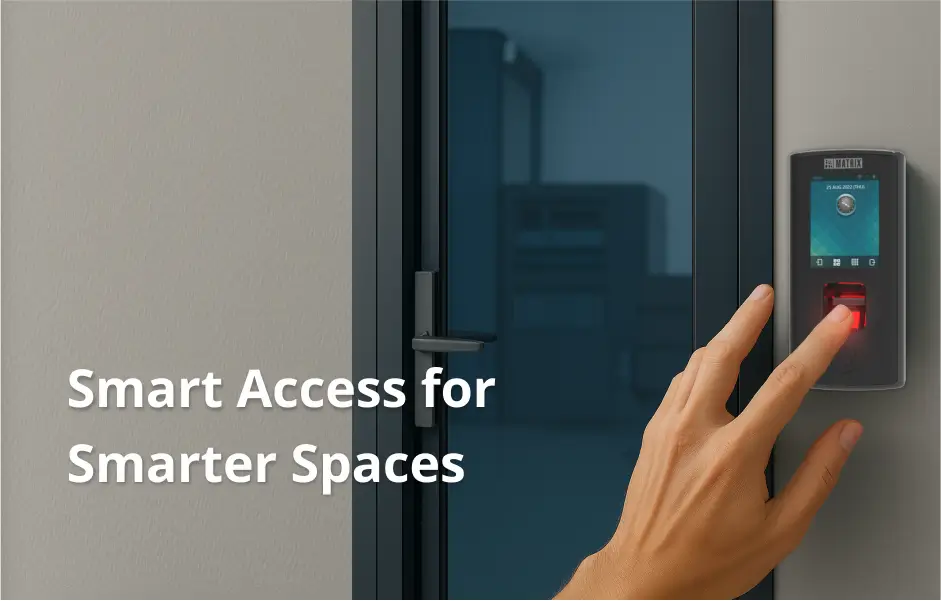
A door access control system is a security solution that regulates entry and exit through doors by verifying a user’s identity and determining whether they are authorized to access a particular area.

Instead of relying on traditional locks and keys, these systems use digital credentials such as

  • RFID cards
  • PIN codes
  • Fingerprint biometrics
  • Face recognition
  • Mobile credentials (Bluetooth, NFC, QR codes)

Once a credential is presented, the system verifies it against predefined access policies. If the credentials match the rules, the door unlocks. If not, access is denied, and the event is logged.

Modern systems also record every entry and exit event, allowing organizations to maintain detailed audit trails for security, compliance, and operational analysis.

Why Are Smart Businesses Adopting Door Access Control Systems?

Organizations today face multiple security challenges: unauthorized entry, insider threats, compliance requirements, and asset protection. A well-implemented door access control system helps businesses become more efficient by addressing these challenges in several ways.

1. Enhanced Security

Access control ensures that only authorized individuals can enter specific areas. Sensitive locations such as server rooms, laboratories, or finance departments can be restricted to selected personnel.

2. Controlled Workforce Movement

Access control policies can regulate who enters which zone and during what time periods. For example, employees may access office floors during working hours but not after hours.

3. Detailed Activity Monitoring

Every access event is recorded, creating a comprehensive log of movement inside the facility. These logs can be used for investigations, audits, or compliance reporting.

4. Prevention of Credential Misuse

Features such as anti-passback prevent employees from sharing their credentials with others. The system ensures that one credential cannot be used multiple times without proper exit registration.

5. Operational Integration

Modern access control systems can integrate with the following:

  • Time and attendance systems
  • Video surveillance
  • Fire alarms
  • Building management systems
  • Payroll software

This creates a unified security and operational environment.

Key Components of a Door Access Control System.

A typical door access control system consists of several interconnected components that work together to secure entry points.

Access Control Panel

The control panel is the central brain of the system. It stores user credentials, processes authentication requests, and controls door operations.

Modern access control panels are powerful computing units that manage thousands of users and multiple doors simultaneously.

Door Controllers

Door controllers connect individual doors to the central panel. They manage door locking mechanisms and communicate with credential readers.

Credential Readers

Readers capture user credentials. Depending on the technology used, they may support the following:

New-generation readers support multiple credential types simultaneously for higher flexibility.

Electronic Locks

Electronic locks replace traditional mechanical locks. They open automatically once authentication is successful.

Exit Devices

Exit buttons or motion sensors allow people to exit controlled areas safely and easily.

Management Software

Management software allows administrators to configure access policies, manage users, generate reports, and monitor system activity in real time.

Important Features to Look for in a Door Access Control System

When selecting a door access control system, organizations should evaluate several critical features.

Three-Dimensional Access Policies

Advanced systems manage access based on three factors:

  • User – who is requesting access
  • Location—which door or zone is being accessed
  • Time – when access is allowed

This model allows precise control over workforce movement.

Real-Time Alerts and Notifications

Modern systems generate instant notifications for security events such as unauthorized access attempts, forced doors, or device failures.

Scalability

A robust solution should support expansion without requiring major infrastructure changes. Some enterprise systems can manage hundreds of doors and tens of thousands of users from a single control panel.

IP-Based Architecture

IP-based systems use standard network infrastructure, simplifying installation and reducing cabling complexity.

Integration Capabilities

Integration with other security and business systems increases the value of access control solutions.

Data Security

Encrypted communication protects credential data from hacking or interception.

Industrial Positioning of Door Access Control Systems 

A door access control system is useful across many industries and environments, including:

  • Corporate offices
  • Manufacturing plants
  • Warehouses
  • Hospitals and laboratories
  • Educational institutions
  • Data centers
  • Retail outlets
  • Hotels and hospitality facilities

Each industry uses access control differently. For example:

  • Hospitals restrict access to operation theaters and laboratories.
  • Manufacturing plants control entry into hazardous areas.
  • Data centers enforce strict authentication policies to protect critical infrastructure.

The Future of Access Control

Access control technology continues to evolve rapidly. Several trends are shaping the next generation of systems.

Touchless Authentication

Face recognition and mobile credentials are becoming more popular due to convenience and hygiene concerns.

Cloud-Based Access Control

Cloud platforms allow organizations to manage multiple locations from a centralized dashboard.

AI-Driven Security Analytics

Artificial intelligence can analyze access patterns to detect suspicious behavior automatically.

Mobile-First Access

Smartphones are increasingly replacing traditional access cards.

These innovations are transforming access control from a basic door management tool into a comprehensive security ecosystem.

Conclusion

As organizations expand and security risks increase, the need for intelligent security infrastructure becomes unavoidable. A modern door access control system provides the foundation for protecting people, assets, and information while enabling efficient facility management.

Businesses today require solutions that combine strong security, operational flexibility, and ease of deployment. Systems designed with IP-based architecture, advanced biometric credentials, and integrated monitoring capabilities deliver exactly that.

Solutions like our Matrix COSEC access control systems are built to address these evolving requirements. With support for modern credentials such as face recognition, mobile authentication, and biometrics, along with flexible access policies and seamless integration with business systems, they provide organizations with a scalable and future-ready approach to physical security.

For businesses looking to upgrade their security infrastructure, investing in the right door access control system is no longer optional—it is a strategic step toward building a safer, smarter, and more efficient workplace.

Employee Time attendance systems and their benefits to your business!

Employee Time attendance systems and their benefits to your business!

employee time attendance and Why are time and attendance systems important? 

It has been suggested that employees spend around four hours per day working on things they weren’t intending to — all thanks to unwanted distractions and a lack of proper time management skills. With time and attendance systems in place, however, this can be prevented.

Time and attendance systems are software or hardware that keep track of the hours an employee works. They can be used to clock in and out, take breaks, and even manage vacation time. Without such systems, employers are often forced to rely on timesheets, which can be easily manipulated.

In this article, we’ll discuss the benefits of using time and attendance systems in your business. We’ll also look at some of the most popular systems on the market, and how they can help you manage your workforce more effectively.

Ready to learn more? Let’s get started.

What are employee time attendance systems?

Have you ever worked for a business that does not use a time and attendance system? If you have, then you know that it can be confusing, frustrating, and at times, detrimental to the productivity of the business as a whole.

Not only do businesses need to track employee hours for payroll purposes, but they also need to track them in order to ensure that employees are working the appropriate number of hours each week. This is where time and attendance systems come in.

Time and attendance systems are software programs or even physical devices that track employee hours. They can be used to record the start and end time of each shift, as well as how many hours an employee has worked. Some systems even allow businesses to track absences and tardiness.

The key features offered by time and attendance systems vary depending on the system, but most systems offer some or all of the following:

  • Clock in and out times
  • Total hours worked for the day
  • Overtime hours worked for the day
  • Paid time off (PTO) accrual
  • Absences and tardines

Types of employee time attendance systems in Ghana

As with any digital workflow tool, time and attendance systems come in different shapes and sizes. There are four main types of time and attendance systems:

  1. Web-based or cloud-based time and attendance systems
  2. Installed or locally hosted time and attendance systems
  3. Standalone time clocks machine
  4. Mobile time tracking apps

Each type of system has its own advantages and disadvantages:

  1. Web-based or cloud-based time and attendance systems are accessible from any internet-connected device, so they’re perfect for businesses with a mobile workforce.

They also tend to be less expensive than other types of systems, since the provider takes care of hosting and maintaining the system. However, they can be less reliable if the internet connection is not reliable.

  1. Installed or locally hosted time and attendance systems are installed on your own network and can only be accessed from computers on that network. They’re more reliable than cloud-based systems, but they can be more expensive to purchase and maintain.
  2. Standalone time clocks machine are simple, standalone devices that employees use to punch in and out. They’re the most affordable type of time and attendance system, but they can be less efficient than other types of systems because they can’t track employee hours or leave balances.
  3. Mobile time tracking appsare apps that employees use to track their hours on their smartphones or tablets. They’re perfect for businesses with a mobile workforce, and they can be more affordable than other types of systems. However, they can be less reliable if employees don’t have a good internet connection.

It’s important to choose the type of system that will best meet the needs of your business, so make sure to do your research before making a purchase.

Benefits of using time and attendance systems

Many businesses find that time and attendance systems are essential in order to effectively manage employee hours. Let’s take a look at some of the benefits that time and attendance systems offer businesses:

1. Increased accuracy and efficiency in time tracking

Time and attendance systems automate the time tracking process, thereby reducing the chances of error. Moreover, employees can easily clock in and out using these systems, which speeds up the process of recording employee hours.

Time tracking is far more accurate when done electronically as opposed to manually. By automating the process, time and attendance systems help businesses maintain accuracy in time tracking, which can be essential for budgeting and payroll purposes.

2. Easier management of employee hours

Managing the schedules of many employees can be a daunting task. Time and attendance systems make it easy for business owners to track employee hours, view schedules, and make changes as needed. This can help businesses ensure that employees are working the appropriate number of hours and that they are properly compensated for their time.

3. Improved communication among employees

Not only do these systems make it easy for employers to track employee hours, but they also help employees keep track of each other’s schedules. This can be helpful for coordinating shift changes and ensuring that everyone is aware of when they are working.

4. Increased accountability among employees

Time and attendance systems also help to hold employees accountable for their time. By tracking the hours that employees work, these systems make it easy to identify employees who are slacking off or working fewer hours than they should be.

These benefits are incredibly useful for businesses of all shapes and sizes; however, they can only be accessed if businesses know how to properly implement and use their system.

How to make the most of your time and attendance system?

When implementing a new system, there are several steps businesses should take to make sure they are getting the most out of their time and attendance system:

Make sure everyone in the company is aware of and understands the system. You can do this by having a company-wide meeting to introduce the system and answer any questions employees may have, or sending out an email with all the pertinent information.

Set up specific times for employees to clock in and out. This will help ensure everyone is following the system correctly and that there is no confusion about when employees are supposed to be working.

Train employees in how to use the system. This is especially important for new employees who may not be familiar with how the system works. Make sure everyone knows how to clock in and out, change their password, and submit time off requests.

Use the system to its full potential. Take advantage of the features your time and attendance system offer to help you manage your business more effectively.

For example, use the reporting feature to track employee hours worked over a certain period of time or the time-off request feature to keep track of employees’ vacation days.

By following these tips, businesses can ensure they are making the most of their time and attendance system and reaping all the benefits it has to offer.

 Finding a time and attendance app

You know what time and attendance apps are and the multitude of benefits they have to offer, from automating payroll processes to safeguarding your business against wage theft. But what’s the best time and attendance app for your business?

There are a few factors to consider when choosing the right time and attendance app for your company. Here are some questions to ask:

  • How many employees do you have?
  • Do you want to track time worked or hours accrued?
  • Do you need a mobile app for employees to clock in and out?
  • Is there a specific hardware requirement, such as time clocks or fingerprint scanners?
  • What features are important to you, such as leave tracking, overtime calculation, or job costing?

HR time and attendance system

Top time and attendance app for your business

Once you’ve answered these questions, you can begin to narrow down the field of time and attendance apps to find the right one for your business.

We recommend our time and attendance tracking app, COSEC APTA, it’s perfect for businesses of all sizes and offers a wide range of features, such as time tracking, GPS tracking, job costing, and more. Plus, it’s easy to use and can be accessed on any device, including smartphones and tablets.

With its user-friendly and intuitive design, COSEC APTA makes tracking employee hours and attendance a breeze. And, with its robust reporting features, you can quickly and easily generate detailed reports on employee time and attendance.

COSEC APTA also features powerful integrations with a variety of leading accounting and HR software, such as Tally,SAP,ERP,HRMS. This means you can easily import employee time data into your accounting or HR system for further analysis.

If you’re looking for a time and attendance app that can help you manage your business more efficiently, we recommend COSEC APTA. It’s easy to use, offers a wide range of features, and integrates with leading accounting and HR software. So why wait? Get started with us today and see the benefits our Time and Attendance Systems will gives your business:

employee clocking systems

Final thoughts

Time and attendance systems are an essential part of any business. They help to automate payroll processes, ensure employees are paid for the hours they work for, and protect your business against wage theft. Choosing the right time and attendance COSEC for your company is essential to getting the most out of these systems.

If you’re ready to automate your time and attendance tracking, it’s time to try out an app like COSEC APTA. To get started, just send us an email info@techfonet.com or call (233) 303972716 /0249180604.

Is Time and Attendance Systems important for businesses?

Is Time and Attendance Systems important for businesses?

Is Time and Attendance Systems important for businesses? 4

Time and attendance systems

Time and attendance systems (TNA) are used to track and monitor when employees start and stop work. A time and attendance system enables an employer to monitor their employees’ working hours and late arrivals, early departures, time taken on breaks and absenteeism. It also helps to control labor costs by reducing over-payments, which are often caused by paying employees for time that are not worked for, and eliminates transcription error, interpretation error and intentional error. TNA systems can also be used to ensure compliance with labor regulations regarding proof of attendance. time and attendance systems

time and attendance systems

Traditionally manual systems were used that rely on paper cards which have times stamped onto them using a time stamping machine. Such machines were used for over a century but have since been phased out and replaced with cheaper automated systems which eliminate the need for payroll staff to manually input employee hours. time and attendance systems

Modern automated time and attendance systems require employees to touch or swipe to identify themselves and record their working hours as they enter or leave the work area. Originally this consisted of using a RFID electronic tag or a barcode badge but these have been replaced by biometrics (vein reader, hand geometry, fingerprint, or facial recognition), and touch screens devices.

The latest technology allows the use of app (Application software) based Geo-fence capabilities.[2] Allowing an employee to clock in & out only when they are within an Internet geolocationFacial recognition systems are also available with these app-based software technologies, eliminating the need for scanners. We at Techfonet provides you with the latest technology that allows you to use fingerprint, Facial recognition, card and Apps system to collect your employee’s attendance data and integrate it into your payroll system for easy data computation.

Our solution allows multiple location setup with centralized data management from the various locations. This enables you to sit in the comfort of your office and collect all attendance data from one centralized location into your payroll system for processing. For more information about our solution kindly visit https://techfonet.com/biometric-solution/ or contact us info@techfonet.com


Reasons why you should consider Time and Attendance Software for your business

Reasons why you should consider Time and Attendance Software for your business

Time and Attendance Software | If you have employees, you have to track their time and attendance. Whether you’re counting the minutes your waiters worked at a restaurant or tracking the number of sick days your executives took from the office, this documentation is key to wage and hour compliance. Of course, you could measure it manually, using written timesheets or clunky spreadsheets, but in the digital age, you’ve got a much better option. At Techfonet, we’re delighted to help businesses, organizations, and institutions streamline their operations and make the most of their workforces with advanced time and attendance software. Our programs can help you increase your production, boost your profits, optimize your office workflow, and more. Read on to top five reasons you should consider time and attendance software for your business.

1. It can automate the often-frustrating process of writing (and changing) schedules.

Time and Attendance software

Working out employee calendars can be a very complex task. Managing your staff’s schedules can feel like quite the juggling act, especially if you’re doing so with a pen and paper or a basic word processing program. Worse yet, once you’ve finally crafted a suitable calendar, it’s nearly inevitable that one or more of your employees will need to make a change, throwing the whole calendar into confusion. Our time and attendance software is equipped with dynamic scheduling capabilities, which can account for your company’s particular patterns and accommodate last-minute schedule switches.

2. Software can safeguard you against employee time theft.

One of your biggest overhead costs is most likely labor. The saying “time is money” is especially true when it comes to the workplace. Through “buddy punching” and other dubious practices, your employees could be costing your company dearly.

3. It can save you thousands of dollars.

In addition to preventing expensive fraud through time theft, time and attendance software can save your company money by:

  • Creating more strategic schedules to limit the amount of overtime you have to pay.
  • Automating accruals for paid time off, benefits, and more so your HR and accounting teams have to spend less of their time (and therefore your money) doing so.
  • Tracking and modifying employee rates as needed during pay periods.
  • Improving communication with employees about their time and attendance to reduce  misunderstandings and increase transparency.
  • Making budgeting and job cost calculations simpler and more effective since time and attendance are more predictable.
  • Matching specific staff members’ areas of expertise with the departments and shifts that can most benefit from them to reduce wasted time and improve efficiency.

4. Utilizing time and attendance software can help you better comply with labor laws and company policies.

As if timesheets weren’t complicated enough, you also have to consider corporate concerns and legal issues. By streamlining the scheduling, clocking in, and accruals processes, our software can help you comply with the Fair Labor Standards Act (FLSA) and other work-related laws. Violations of these regulations could cost you money, time, effort, employees, or even your reputation, so you should take them seriously. Our flexible, customizable programs can also help you devise and implement improved company policies to increase your profits and suit your specific needs.

5. It can help you better manage your operations through reports.

We aim to provide our clients with valuable data they can use to run their businesses well. A key aspect of our time and attendance software is its ability to author customized reports. You can leverage the information gathered by our programs to track and improve projections, performance, production, and punctuality, among other key factors.